
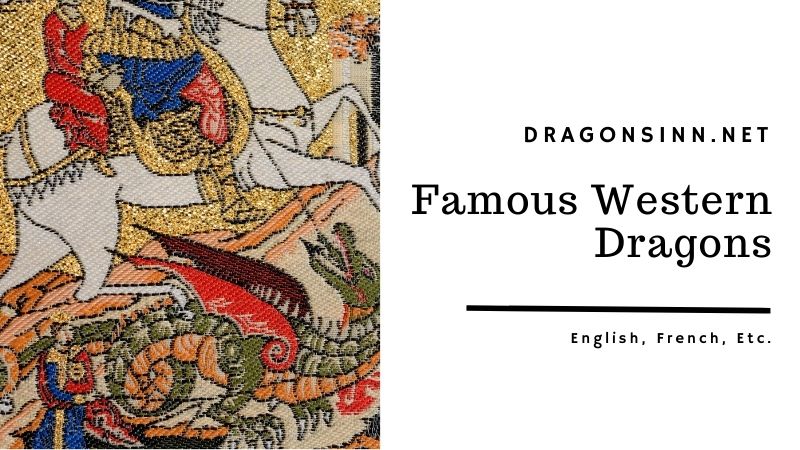
Originally published 1 July 2008. Last updated 5 September 2025. On famous Western dragons and their folklore.
Check out our earlier post on Western dragon history too.
Famous Western Dragons
Famous English Dragons
Famous French Dragons
Famous Greek / Roman Dragons
Famous Norse Dragons
Famous Swiss Dragons
German Dragons
English Dragons
– [Celtic] The magician Merlin in the Arthurian legends is said to have been the child of a human mother and an incubus. He had no father in the traditional sense. Vortigern was told by his seers to sacrifice a boy with no father when he had trouble building a tower on Dinas Emrys. However, Merlin predicted that the tower was built on an underground pool and that there were two dragons lying there: one red and one white. When Vortigern had ordered the pool to be drained, the two dragons awoke, and began to fight, and Merlin’s words were:

15th century illustration of the pool’s battling dragons
“Alas for the Red Dragon, for its end is near. Its cavernous dens shall be occupied by the White Dragon, which stands for the Saxons which you have invited over. The Red Dragon represents the people of Britain, who will be overrun by the White One…” [Geoffrey of Monmouth 171]
Learn more about the history of dragons, or check out our collection of dragon quotes!
– [English] The Lambton Worm is the next on our list of famous western dragons. It was hauled out of the river by John Lambton, heir to Lambton castle, who was fishing. He rid himself of the vile creature by throwing it down a nearby well. However, it grew larger and more powerful. One day, villagers spied a glistening trail from the well to a hill. There, the dragon was coiled around the hill nine times. Its reign of terror laid waste the once lush countryside and devoured livestock and small children.
John Lambton returned years later and sought the advice of an old witch to kill the worm. He was given a special suit of armour and told to kill the next living thing he met after slaying the creature. After destroying the worm, the first living thing to greet him happened to be his father. Failing to kill his own father, John Lambton killed his most faithful dog. This sacrifice was not enough and all the heirs were cursed for the next nine generations.
– [English] Maud was a girl from the county of Herefordshire, and she chanced upon a baby wyvern looking lost and dejected as she was walking in the woods. Its sadness dissipated once it saw her, and it was overjoyed that it was no longer alone. She was enchanted by her unexpected playmate, but her parents did not share her delight in her little companion.
So she spent many hours with her new-found pet in a secret nook in the forest. However, the day came when the wyvern could no longer be sustained on saucers of milk. It started feeding on the community’s livestock, then moved on to having a taste for humans. Maud was the only person that was completely safe from the now adult wyvern. Inevitably, a knight, Garston, decided to chivalrously rid the town of the dragon. He engaged the dragon in battle and plunged his lance into its throat. Just as he was about to deliver the final blow, Maud came screaming out of the nearby bushes. Unnerved, Garston rode away to the joy of the joyful villagers, leaving behind a dying monster with its only friend – a girl called Maud whose innocent childhood had been abruptly and savagely ended.

Paolo Uccello’s version of the St. George story
[English] St George and the Dragon: The story we know today dates from the bards of the 14th century. According to legend, a pagan town was being terrorised by a dragon. The locals kept sacrificing sheep to please it, and when it still remained unsatisfied, they started sacrificing some of their people. Finally the local princess was to be thrown to the beast, but Saint George came along, slaughtered the dragon and rescued the fair princess. This is perhaps a symbol of Christianity’s dominance over paganism. St. George became the Patron Saint of England by the 14th century, replacing St Edward. It was at Agincourt that Henry V is said to have called:
“God for Harry, England and Saint George.”
References for Famous Western Dragons (English):
Books –
1. Pitkin Guide, King Arthur
2. Dragons: A Natural History by Dr. Karl Shuker
Websites –
> Arthurian Legend > The Lambton Worm
French Dragons
– The Vouivre [a.k.a Wouive] is a French Wyvern depicted with the head and upper body of a beautiful woman. The word derives from the old Gaulish Wouivre, meaning spirit. A ruby, blood red carbuncle set between her eyes helps her find her way through the mortal Underworld. The jewel guides this protector of earth and all living things through the mortal underworld. Her scales sparkled like diamonds and she had a crown of pearls. On some occasions the dragon became depicted as half-woman and half winged snake.
– The Tarasque haunted the banks of the River Rhone in Nerluc. It had six limbs and was spawned by the serpent Leviathan, but in time it came to haunt Southern France. A traveller named Jacques du Bois was journeying along the banks of that river one evening, and he was so focused on the terrifying rumours he had heard of the Tarasque that he failed to hear a deep rumble. Suddenly the Tarasque appeared and with a deafening roar, it ignited the luckless du Bois with a steady stream of fire.

Ancient postcard showing the Tarasque
St. Martha, whose inspirational preaching had brought joy and hope to all that met her, was implored to free the townspeople of Nerluc. When she encountered the Tarsque, she held two branches up in the shape of a cross and the mighty creature was subdued. She led it back to Nerluc with a woven collar with braids of her hair and the townspeople grew fearless, kicking and hurling rocks at the Tarasque. It cowered in fright and St. Martha pleaded with the people to forgive the beast, but to no avail.

Another picture of the Tarasque
The Tarasque eventually rolled over and died. Nerluc is now called Tarascon, and a tarasque festival is held each Whitsun to remember their former oppressor.
– The Peluda was an amphibious dragon, also known as the shaggy beast because it was covered with countless numbers of spiny bristles. It had refused to enter Noah’s Ark, yet had miraculously survived the Great Flood and was now terrorizing the lands of La Ferte-Bernard. It could kill a person with a mighty thwack of its tail, and a single blast of flame could incinerate fields for miles around.
It started to devour fair maidens, but the fateful morning arrived where one of those fair maiden’s valiant fiance sprang up to do battle with the Peluda. The bold youth did not aim for the dragon’s throat, but hacked at its mighty tail instead. Immediately, the Peluda keeled over and perished, as its tail was the only part of its body that was susceptible to mortal injury. Its conqueror was hailed as a hero and there was much rejoicing in La Ferte-Bernard. Needless to say he and his bride lived happily ever after.
References for Famous Western Dragons (French):
Books –
1. Dragons: A Natural History by Dr. Karl Shuker
Websites –
> The Serene Dragon > The Tarasque
Greek Dragons

“Ladon”
NOTE (5 Sept 2025): Greek dragons, with their golden apples and sea-bound sacrifices, will have their own blog post in the near future. The Roman serpent of Carthage will be left here for now until additional research notes are gathered.
– Ladon was the hundred-headed dragon that guarded the golden apples in the garden of the Hesperides, nymphs who were daughters of Atlas [the titan who held the sky and the earth upon his shoulders]. Hercules eleventh labour consisted of stealing these golden apples. Since the Garden of Hesperide’s dragon knew Atlas, Hercules had to persuade him to steal the apples while he stayed to support the sky in his place. Atlas, who had a loathing for his task as punishment following the downfall of the Titans, intended to leave Hercules with the weight of the world upon his shoulders. Hercules asked Atlas whether he could take it back, just for a moment, while the hero put some soft padding on his shoulders to make the job more comfortable. Atlas placed the apples on the ground and lifted the burden. Hercules seized the apples and quickly ran off.
– Lernean Hydra [info can be found here]
– Cetus, the Dragon of Poseidon: Perseus, travelling on his winged sandals, noticed a maiden, who was tied up and gazing fearfully at the sea. She looked at him, and proceeded to tell her story. She was Princess Andormeda. Her mother was a vain woman who claimed that she was even lovelier than the sea nymphs known as the Nereids.

Cetus from Johan van Keulen’s Boeck zee-kaardt, 1709.
The sea god Poseidon then called Cetus, a serpent dragon, from the depths of the ocean, and ordered it to create havoc in their land. The people called out in fear, and he told them that only the queen’s daughter’s sacrifice could rid them of the monster. As the princess ended her sad tale, the serpent dragon surfaced. It resembled a giant whale with large ivory tusks and its head was like a hound’s, Perseus waited to make his move. While the dragon was intent on the lady, Perseus swung in, and thrust his sword underneath the head of the monster. It collapsed, and floated down to the depths of the sea.
– The Dragon of Rhodes: There is a legend of a brave knight known as Gozon, who sought to slay a fearsome dragon which roamed the Greek Isle of Rhodes in the Mediterranean. This dragon enjoyed preying on fair maidens and the local peasantry. However, Gozon was determined to rid Rhodes of this menace so he built a model of the creature from the descriptions he had heard. He trained his dogs to attack it and sought the dragon in its lair after much practice. Gozon stabbed the dragon in the neck as the creature fought off the attacking dogs, effectively ending the terror of the inhabitants of the island. The skull of the Dragon was said to have remained above the Amboise Gate until 1837. Gozon died in 1353, and his tomb is said to have been the only inscribed with the words, “Here lies the Dragon Slayer.”
– A serpent giant in the ancient city of Carthage was a deadly obstacle to the Roman army, led by the general Regulus. The enormous serpent had a flattened head and glowing eyes, and its jaws were lined with rows of fangs. It lurked among the reed beds of the river Bagrada. The army had to cross the river but the water started to boil as soon as the first man stepped in. The serpent mercillessly coiled around and dragged the man down to his death beneath the water. The plan Regulus devised in the end was similar to the tactics in besieging a real fortress. Boulders were bombarded at the serpent until its skull was smashed. The Carthaginian serpent was skinned [it was 120 feet/37m] and Regulus presented the skin and jaws to the city of Rome upon his victorious return. An ovation was granted to the general and the remains of the serpent were displayed in a temple on Capitol Hill. The remains disappeared during the Numantine War in 133 B.C.
References for Famous Western Dragons (Greek):
Books –
1. Ultimate Encyclopedia of Mythology by Arthur Cotterell & Rachel Storm
2. Dragons: A Natural History by Dr. Karl Shuker
Websites –
> Ancient Sprial Dragon Serpent > What is Better Than Slaying a Dragon
Famous Western Dragons: Norse

Death of Beowulf – illustration by George T. Tobin [colourised by B. Slade]
– The Firedrake is the dragon that Beowulf fought his final battle with as the aging hero died of his wounds. The dragon is described as being winged and having fire-breathing abilities. Beowulf, written in Old English sometime before the tenth century A.D., describes the adventures of a great Scandinavian warrior of the sixth century. It is one of the oldest surviving epics. A slave stumbles into the dragon’s hoard and steals a cup, and this infuriates the dragon so much that it sets fire to the local district. Beowulf, having enjoyed 50 years of his reign as king, sets out with his young warriors in pursuit and challenges the dragon to a combat that proves to be fatal for both of them.
– Nidhogg or Nidhoggr [also known as the “Dread Biter”] was one of the most feared of the early Nordic dragons. He lived at the foot of the world ash tree, Yggdrasil. The tree had three great roots, one of which reached over the freezing mist and darkness of Niflheim where Hel reigned as Queen of the Norse Underworld. Nidhogg could also be found at Hvergelmir [the bubbling cauldron], the spring in Niflheim which is the source of all the rivers of the world. Nidhogg was a dragon that devoured the corpses of evil-doers, and he would gnaw at the roots of Yggdrasil when he got tired of the taste of dead flesh. Since the world tree supported all life and Nidhogg attempted to destroy it, Nidhoggr was personified as evil itself.
Both Yggdrasil and Nidhogg were destined to survive the final catastrophe of Ragnarok, the doom of the gods and ultimately, the end of the world. Fires and floods would not deter the dragon from its incessant feasting on the boundless supply of the dead.

Thor wresting with Jormungand at Ragnarok, by James Alexander, 1995
– Jormungand or Jormungandr [the Migard/World Serpent] is the world serpent that lies in the seas with its tail in its mouth, encircling the land and creating the oceans. In Norse mythology it was the serpent son of Loki, god of fire, and brother of Fenrir and Hel.

[full size] Midgard serpent devouring itself
Odin arranged for these monstrous children to be kidnapped and brought to Asgard. He threw Jormungand into the icy ocean, where he grew to such a monstrous size that he encircled Midgard [the world of men], eventually bitings its own tale and hence becoming known as the Midgard Serpent. This links Jormungand to Ouroboros, the Egyptian cyclic serpent. At Ragnarok he would meet and be slain by his arch-rival, Thor. Thor would also die – by Jormungand’s venom.
– Fafnir was the son of the magician Hreidman, who had been corrupted by a cursed ring called Andvarinaut. He lusted after his father’s rings, and with the help of his brother, Regin, they killed him. Fafnir’s greed grew to be so great, that it not only made him monstrous in nature, but also monstrous in form. He was turned into a terrible dragon. Over a period of time, he managed to collect a massive number of treasures and vigilantly guarded this hoard. This drew many a valiant hero to his lair in search of both wealth and fame.
Most of them however, met their untimely deaths by the dragon’s fiery breath. There was one hero though, who did manage to outwit the dragon. That hero was Sigurd*, who was guided by Regin and armed only with his father’s sword. However despite his heroic deed which won him fame and fortune, his life from then on was said to be ruined by the curse that came with the ill-fated treasures.
* Sigurd, better known as Siegfried [German], was one of the great heroes depicted in the early European Teutonic and Old Norse literature. Whether he was a historical figure or merely a legendary one is unknown. Some scholars believe that behind the legends there was a real person who lived sometime during the Merovingian Dynasty (481-750), which is now France. In most stories he appears as the leading character, a triumphant, dragon-slaying hero of courage and strength.
References for Famous Western Dragons (Norse):
Books –
1. Ultimate Encyclopedia of Mythology by Arthur Cotterell & Rachel Storm
2. Dragons: A Natural History by Dr. Karl Shuker
Websites –
and many more cross-referenced for accuracy
Famous Western Dragons: Swiss
– The Dragon of Mount Pilatus was a dragonet, scarcely larger than a man, but this did not mean it was less deadly. This dragon’s blood was instantly lethal to anything it touched. The Swiss town of Wilser had come under the dragonet’s tyranny for years, and no one was skilled enough in swordplay to come close to slaying it.
There had been a man called Winckelriedt earlier in Wilser, but he was banished because of a conviction for manslaughter. However since he was the only one proficient with weapons, he was soon called back to destroy the dragon. After a long arduous climb up the steep slopes of Pilatus, Winckelriedt met the dragonet face-to-face in direct combat. The dragon’s head was swept off when its curving neck came too close to the blade. However, this sealed Winckelriedt’s fate too because a trickle of the dragonet’s blood touched his hand as he raised his sword up in victory. Before he could utter a word, he was dead from the avenging blood.
– The Tatzelworm [also known as Stollenwurm, or hole-dwelling worm] is said to be snakelike, measuring about 4-5 feet [1.2-1.5m] with two visible forelegs.
Some reports even describe it as being catlike. In the summer of 1921, at Hochfilzen in southern Austria, a tatzelworm was reported to have leapt at a herdsman and a poacher who shot at it. Both men fled the scene. In 1954, a cat-headed snakelike beast was seen attacking a herd of pigs further south near Sicily. Zoologists however, have not been able to get any tatzelworm bodies for study. They have suggested it could be a large, undiscovered lizard though.

A dragon boat in Lucerne © MentalWanderings.com
– The two dragons of Lucerne. The town of Lucerne in Switzerland was famed for its winged dragons which were said to look like flying crocodiles. A tale of a man who once fell into an underground cave from which he could not escape is told there. He realised with much horror that this was the home of two dragons. However, the dragons seemed quite pleased to have a new friend in their abode. The man lived in the cave for five months, living on nothing but grass and a trickle of water which dripped down the rocks. When spring came, the dragons decided to leave their home, and took off into the air. The man realised that this was his only chance to escape. He grabbed the tail of one of the creatures, and was flown out of the cave. Sadly, the man dies in the end. One version tells that he had been without food for too long, and he died shortly after returning to his home village. Another version is that he did reach his hometown, where he feasted for three whole days. To his death.
References for Famous Western Dragons (Swiss):
Books –
1. Dragons: A Natural History by Dr. Karl Shuker
Websites –
> Dragon Caverns > Alpine Tatzelworm
German Dragons
Learn about German Dragons in a separate in-depth post (by guest blogger Zar Antonov).